

 wewe
wewe 
Exchange inflows are a widely watched metric in cryptocurrency markets, offering insight into how assets move between private wallets and trading platforms. While price shows direction, inflows can hint at underlying intent—especially when large amounts of crypto are involved.
For traders and analysts, understanding exchange inflows helps add context to market behavior.
What Are Exchange Inflows
Exchange inflows refer to the amount of cryptocurrency transferred from external wallets into exchange platforms over a given period.

These movements are visible on public blockchains and are often tracked using analytics tools.
Common interpretations include:
- Movement from private wallets to exchanges
- Potential preparation for trading activity
- Increased liquidity entering the market
However, inflows alone do not confirm intent—they simply show where assets are moving.
How Exchange Inflows Work
Every time crypto is sent to an exchange address, it is counted as an inflow.
The process typically involves:
- A wallet initiates a transfer
- Funds are sent to an exchange-controlled address
- The transaction is recorded on the blockchain
- Analytics platforms aggregate and display the data
Because exchanges are central points for buying and selling, inflows often attract attention from traders.
Exchange Inflows vs Outflows
Understanding the difference between inflows and outflows is essential.
| Metric | Exchange Inflows | Exchange Outflows |
|---|---|---|
| Direction | Wallet → Exchange | Exchange → Wallet |
| Common Interpretation | Potential selling pressure | Potential holding behavior |
| Market Impact | May increase liquidity | May reduce available supply |
| Signal Type | Caution or activity | Accumulation signal |
| Usage | Sentiment analysis | Supply analysis |
Both metrics are often analyzed together for better context.
Pro Insight
A sudden spike in inflows doesn’t always mean immediate selling. Sometimes it reflects internal transfers, institutional movement, or preparation for liquidity rather than actual trade execution.
Why Exchange Inflows Matter
Exchange inflows are closely tied to potential market behavior.
They can indicate:
- Increased selling pressure if assets are moved to exchanges
- Rising market activity during volatile periods
- Changes in investor sentiment
Large inflows from known “whale” wallets often draw particular attention.
Factors That Influence Inflows
Several factors can drive changes in exchange inflows:
- Market volatility
- Price rallies or declines
- Institutional activity
- Regulatory news or macro events
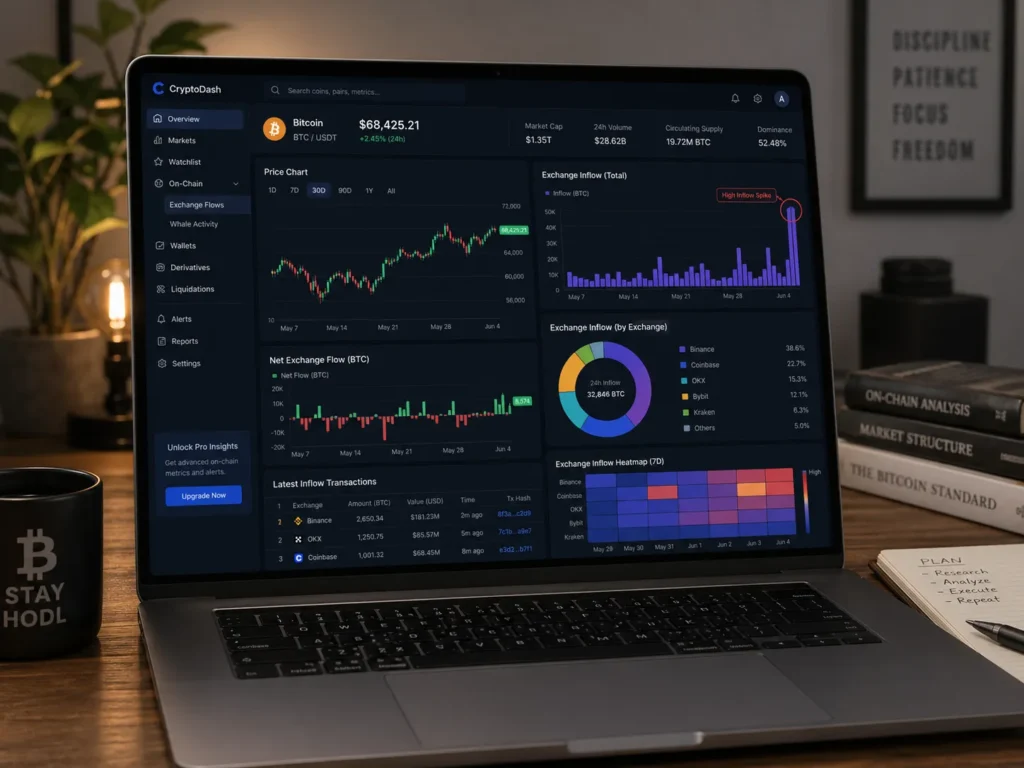
During uncertain conditions, inflows may increase as investors prepare to adjust positions.
Quick Tip
Always compare inflow data with price trends and trading volume. A single metric rarely provides enough context on its own.
Real World Scenario
Imagine Bitcoin experiencing a sharp price increase.
At the same time, exchange inflows spike significantly.
This combination might suggest that some investors are preparing to sell into strength, potentially increasing short-term supply in the market.
However, if inflows rise without corresponding selling pressure, it may simply reflect repositioning rather than immediate action.
Common Misinterpretations
Exchange inflows can be misunderstood if taken at face value.
- Assuming all inflows lead to selling
- Ignoring exchange internal transfers
- Overreacting to short-term spikes
- Not considering broader market context
Recognizing these limitations helps maintain balanced analysis.
Frequently Asked Questions
What are exchange inflows in crypto
They are the amount of cryptocurrency transferred into exchange wallets from external addresses.
Do exchange inflows mean price will drop
Not necessarily, but they can indicate potential selling pressure.
How are inflows tracked
They are tracked using blockchain data and analytics platforms that monitor wallet activity.
What is a high inflow signal
A sudden increase compared to normal levels is often considered significant.
Are inflows more important than price
No, they are used alongside price and other metrics for a complete analysis.
Conclusion
Exchange inflows provide a valuable lens into how assets move within the crypto ecosystem. While they don’t predict outcomes on their own, they offer important context—especially when combined with price action and other indicators.
Used carefully, this metric can help traders better understand market dynamics and avoid reacting solely to surface-level movements.
https://www.sec.gov
https://www.cftc.gov
https://www.investor.gov
https://www.federalreserve.gov
This article is for general informational purposes only and does not provide legal, financial, medical, or professional advice. Policies, rates, and regulations may change over time.