
 wewe
wewe 
Blockchain data tools have become essential for anyone working with cryptocurrency, from traders and analysts to institutions and developers. These tools turn raw blockchain activity into structured insights, helping users understand how funds move, where trends are forming, and what risks may exist.
In a system where all transactions are public, the real advantage comes from knowing how to interpret that data.
What Are Blockchain Data Tools
Blockchain data tools are software platforms designed to collect, analyze, and interpret data from blockchain networks such as Bitcoin or Ethereum. (BYDFi)
They help users:
- Track transactions and wallet activity
- Analyze market behavior and trends
- Detect unusual or suspicious movements
- Build dashboards for research or trading
At a deeper level, these tools apply data science techniques to blockchain ledgers to generate usable insights. (ChainUp)
Types of Blockchain Data Tools
Blockchain tools fall into several categories depending on their use case.
On-Chain Analytics Platforms
These focus on interpreting blockchain activity such as transactions, wallet balances, and token flows.
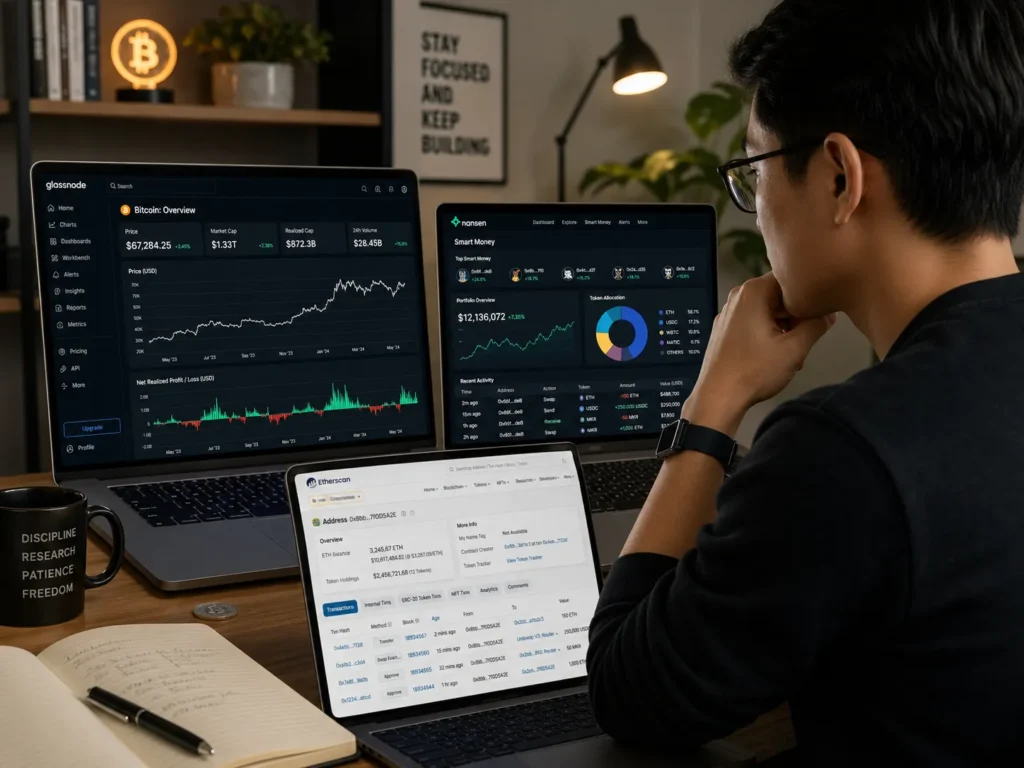
Examples include platforms like Glassnode, Nansen, and CryptoQuant, which provide insights into market behavior and investor activity. (nansen.ai)
Blockchain Explorers
Explorers allow users to directly view transactions, blocks, and wallet balances.
They are often used for:
- Verifying transactions
- Tracking wallet history
- Checking network activity
These are the most basic tools but form the foundation of blockchain transparency.
Institutional Analytics and Compliance Tools
These tools are used by governments, exchanges, and financial institutions to monitor risk and ensure compliance.
Platforms like Chainalysis help organizations track crypto activity, detect fraud, and support investigations. (Chainalysis)
Developer and Data Query Tools
Some platforms allow users to query blockchain data directly or build custom dashboards.
For example, tools like Dune Analytics enable users to write queries and create visual dashboards from raw blockchain data. (formo.so)
Popular Blockchain Data Tools Compared
| Tool Type | Key Function | Typical Users |
|---|---|---|
| Glassnode | Market intelligence | Traders, analysts |
| Nansen | Wallet tracking & labeling | Investors, researchers |
| Dune Analytics | Custom data dashboards | Developers, analysts |
| Chainalysis | Compliance & investigations | Institutions, regulators |
| DeFiLlama | DeFi tracking | DeFi users, investors |
Each tool serves a different purpose, and many users combine multiple platforms for deeper analysis.
Pro Insight
No single blockchain tool provides a complete picture. Experienced analysts often use a combination—one tool for data discovery and another for confirmation—to reduce bias and improve accuracy.
How Blockchain Data Tools Are Used
These tools support a wide range of real-world applications.
- Trading and investing
Identifying trends, tracking large wallet movements, and analyzing liquidity - Risk management
Detecting suspicious transactions or high-risk addresses - Research and analytics
Understanding network growth, adoption, and usage patterns - Compliance and regulation
Supporting anti-money laundering efforts and transaction monitoring
Because blockchain data is permanent and transparent, these tools help convert raw records into meaningful intelligence.
Quick Tip
Start with a simple combination: use a blockchain explorer for raw data and an analytics platform for interpretation. This helps build understanding without overwhelming complexity.
Limitations to Keep in Mind
While powerful, blockchain data tools are not perfect.
- Wallet identities are often anonymous
- Data interpretation requires context
- Signals can be misread without experience
- Different tools may show slightly different metrics
Understanding these limitations helps avoid overconfidence in any single dataset.
Real World Scenario
Imagine a trader monitoring Ethereum activity.
They use:
- A wallet tracking tool to identify large transactions
- An analytics dashboard to confirm rising network activity
- A DeFi tracker to monitor liquidity changes
Instead of relying on one signal, they combine multiple tools to build a clearer market view.

Frequently Asked Questions
What are blockchain data tools used for
They are used to analyze blockchain transactions, track wallet activity, and understand market behavior.
Are blockchain data tools free
Some tools offer free versions, while advanced analytics platforms often require subscriptions.
Can beginners use blockchain analytics tools
Yes, many platforms provide dashboards and visualizations designed for non-technical users.
Do blockchain tools show wallet owners
Not directly. Most wallets are anonymous, though some tools label known entities like exchanges.
Which blockchain data tool is best
There is no single best tool. Different platforms serve different purposes depending on your needs.
Conclusion
Blockchain data tools play a critical role in making sense of decentralized systems. By transforming raw transaction data into actionable insights, they help users navigate the crypto ecosystem with more clarity.
Whether you’re analyzing markets, tracking activity, or conducting research, using the right combination of tools can significantly improve your understanding of how blockchain networks operate.
https://www.sec.gov
https://www.cftc.gov
https://www.investor.gov
https://www.federalreserve.gov
This article is for general informational purposes only and does not provide legal, financial, medical, or professional advice. Policies, rates, and regulations may change over time.