
 wewe
wewe 
Automated trading has transformed how individuals and institutions participate in financial markets. By using software to execute trades based on predefined rules, investors can remove much of the manual effort and emotional decision-making from the process.
In fast-moving markets, this approach offers both efficiency and consistency—when used correctly.
What Is Automated Trading
Automated trading refers to the use of algorithms and software to execute trades without manual intervention. Once a strategy is programmed, the system monitors market conditions and places trades automatically.
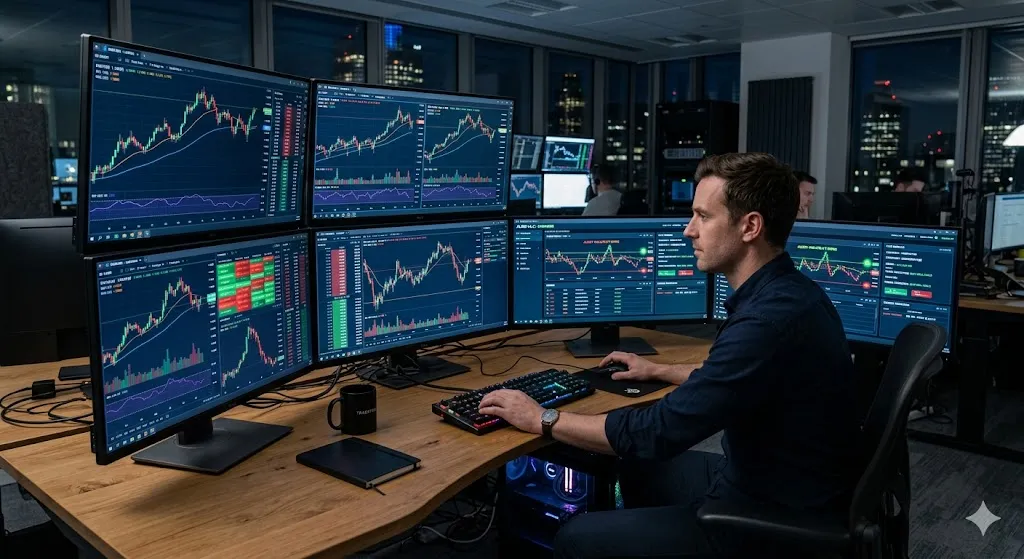
These systems are commonly used in:
- Stock markets
- Cryptocurrency trading
- Forex markets
At its core, automated trading is about following rules consistently rather than reacting emotionally.
How Automated Trading Works
The process involves several key components:
- Strategy creation
Define rules based on indicators, price levels, or conditions - Algorithm execution
The system scans markets in real time - Order placement
Trades are executed instantly when conditions are met - Monitoring and adjustment
Performance is reviewed and strategies refined
Because the system operates continuously, it can respond faster than manual trading.
Automated Trading vs Manual Trading
| Feature | Automated Trading | Manual Trading |
|---|---|---|
| Execution Speed | Instant | Slower |
| Emotional Influence | Minimal | High |
| Time Commitment | Low after setup | High |
| Consistency | High | Variable |
| Flexibility | Rule-based | Adaptive |
Both approaches have strengths, but automation emphasizes discipline and efficiency.
Pro Insight
Automation amplifies your strategy. A strong strategy becomes more consistent, while a weak one can produce losses more quickly. The quality of your rules matters more than the automation itself.
Common Types of Automated Trading Strategies
Different strategies are used depending on market conditions.
- Trend-following strategies
Buy when markets rise, sell when they fall - Mean reversion strategies
Assume prices return to average levels - Arbitrage strategies
Exploit price differences across markets - Grid trading
Buy and sell within a defined price range
Each approach requires careful configuration and testing.
Benefits of Automated Trading
Automated systems offer several advantages:
- 24/7 market monitoring
- Faster trade execution
- Reduced emotional bias
- Ability to manage multiple positions simultaneously
These benefits are especially valuable in volatile or fast-moving markets.
Risks and Limitations
Automation does not eliminate risk.
Key limitations include:
- Dependence on strategy quality
- Inability to react to unexpected events
- Technical failures or system errors
- Over-optimization based on past data
Markets can change quickly, and automated systems may not adapt instantly.
Quick Tip
Test your strategy in a simulated environment before using real funds. This helps identify weaknesses without exposing capital to unnecessary risk.
Real World Scenario
A trader builds an automated strategy based on trend-following indicators.
- In a trending market, the system performs well
- In a sideways market, frequent false signals lead to losses
This demonstrates how performance depends on market conditions—not just the system itself.
Common Mistakes to Avoid
- Using automation without understanding the strategy
- Expecting consistent profits in all market conditions
- Ignoring risk management rules
- Overcomplicating strategies with too many indicators
Avoiding these mistakes can improve long-term outcomes.

Frequently Asked Questions
What is automated trading
It is the use of software to execute trades based on predefined rules without manual intervention.
Is automated trading profitable
It can be, but results depend on strategy, market conditions, and risk management.
Can beginners use automated trading
Yes, but understanding basic trading concepts is important before starting.
Does automated trading remove risk
No, it reduces emotional decision-making but does not eliminate market risk.
What markets support automated trading
It is commonly used in stocks, crypto, and forex markets.
Conclusion
Automated trading offers a powerful way to participate in financial markets with greater efficiency and consistency. By relying on structured rules rather than emotions, it can improve discipline and execution speed.
However, success depends on strategy quality and risk management. When used thoughtfully, automated trading can be a valuable tool—when used blindly, it can amplify mistakes just as quickly.
https://www.sec.gov
https://www.cftc.gov
https://www.investor.gov
https://www.federalreserve.gov
This article is for general informational purposes only and does not provide legal, financial, medical, or professional advice. Policies, rates, and regulations may change over time.