

 wewe
wewe 
Open interest is a core concept in derivatives trading, often used to understand market participation and sentiment. While price charts show where the market has been, open interest helps reveal how much activity is building behind those movements.
For traders in futures and options markets, it offers a deeper layer of context that goes beyond price alone.
What Is Open Interest
Open interest refers to the total number of outstanding derivative contracts—such as futures or options—that have not been settled. Each contract represents an agreement between a buyer and a seller.

When a new contract is created, open interest increases. When a contract is closed or expires, open interest decreases.
This makes it a useful indicator of how much capital is currently active in a market.
How Open Interest Works
Open interest changes based on trader activity rather than price movement alone.
Here’s how it typically behaves:
- New buyers and sellers enter → Open interest increases
- Existing positions close → Open interest decreases
- Positions transfer between traders → Open interest stays the same
Unlike trading volume, which measures activity over a period, open interest shows the total number of active positions at a given time.
Open Interest vs Trading Volume
These two metrics are often confused, but they serve different purposes.
| Feature | Open Interest | Trading Volume |
|---|---|---|
| Measures | Active contracts | Contracts traded |
| Time Frame | Cumulative | Per period |
| Indicates | Market participation | Market activity |
| Impact of Closing Trades | Decreases | Still counted |
| Use Case | Trend confirmation | Short-term momentum |
Using both together provides a more complete picture of market behavior.
Pro Insight
Rising open interest alongside a strong price trend often suggests that new money is entering the market. This can strengthen the trend’s credibility, though it doesn’t guarantee continuation.
Why Open Interest Matters
Open interest helps traders interpret what’s happening behind price movements.
Common interpretations include:
- Rising price + rising open interest → Trend may be strengthening
- Falling price + rising open interest → Increasing bearish sentiment
- Rising price + falling open interest → Short covering, not new demand
- Falling price + falling open interest → Weakening trend
These patterns are not absolute signals but offer useful context.
Factors That Influence Open Interest
Several elements can affect open interest levels:
- Entry of new traders into the market
- Expiration cycles of contracts
- Changes in market sentiment
- Institutional activity
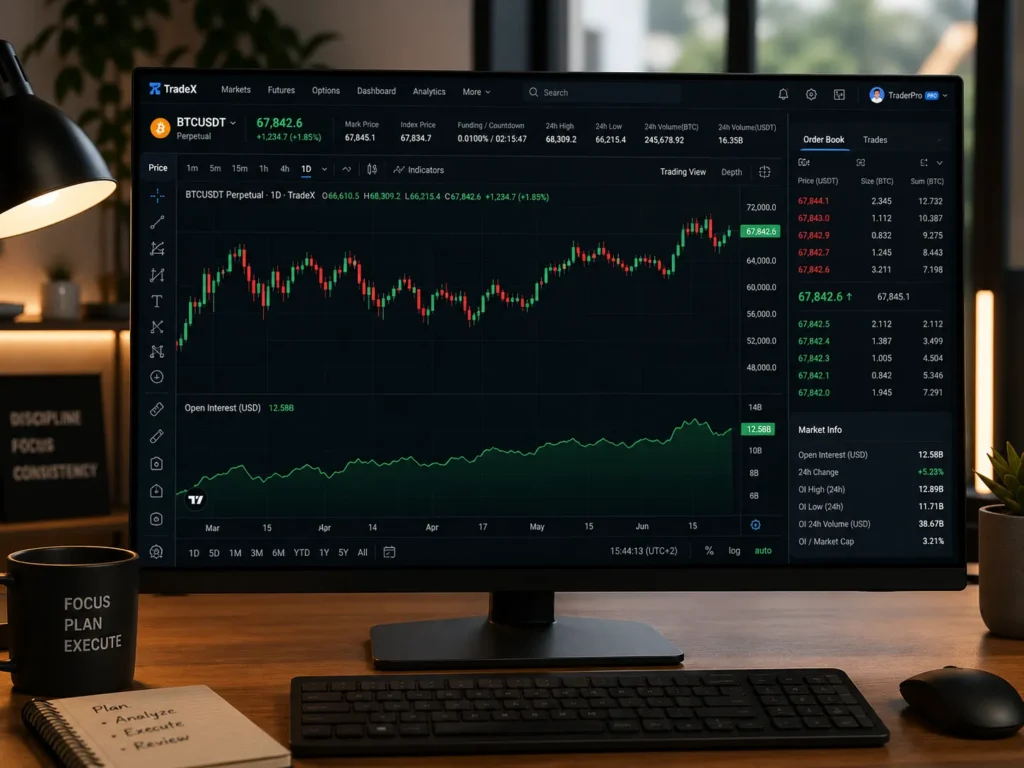
In fast-moving markets, open interest can shift quickly as positions are opened and closed.
Quick Tip
Always analyze open interest alongside price and volume. Looking at it in isolation can lead to incomplete conclusions.
Real World Example
Consider a futures market where prices are steadily rising.
If open interest also increases during this period, it suggests that new participants are entering long positions, reinforcing the upward trend.
On the other hand, if prices rise but open interest falls, it may indicate that traders are simply closing short positions rather than opening new long ones.
This distinction can influence how traders interpret the strength of a move.
Common Limitations
While useful, open interest has its constraints:
- It does not reveal trader intent directly
- It cannot distinguish between hedging and speculation
- Sudden changes may be tied to contract expiration
- Interpretation requires context with other indicators
Understanding these limitations helps prevent overreliance on a single metric.
Frequently Asked Questions
What does open interest mean
It represents the total number of active derivative contracts that have not been closed or settled.
Is high open interest good or bad
It is neither inherently good nor bad; it simply indicates higher market participation.
How is open interest different from volume
Open interest tracks active contracts, while volume measures how many contracts are traded over a period.
Can open interest predict price movement
It can provide context for trends but does not guarantee future price direction.
Does open interest apply to stocks
It primarily applies to derivatives like futures and options, not directly to stock trading.
Conclusion
Open interest is a valuable tool for understanding the depth and participation behind market movements. While it doesn’t act as a standalone signal, it adds meaningful context when combined with price and volume analysis.
For traders looking to refine their market perspective, it serves as a practical indicator of how positions are building—or unwinding—over time.
https://www.cftc.gov
https://www.sec.gov
https://www.investor.gov
https://www.federalreserve.gov
This article is for general informational purposes only and does not provide legal, financial, medical, or professional advice. Policies, rates, and regulations may change over time.