

 wewe
wewe 
Spot trading without leverage becomes far more effective when you understand how to use market and limit orders. These two order types shape how your trades are executed—whether you prioritize speed or price control.
For traders working only with their own capital, mastering these basics can improve consistency and reduce unnecessary costs.
What Market and Limit Orders Are

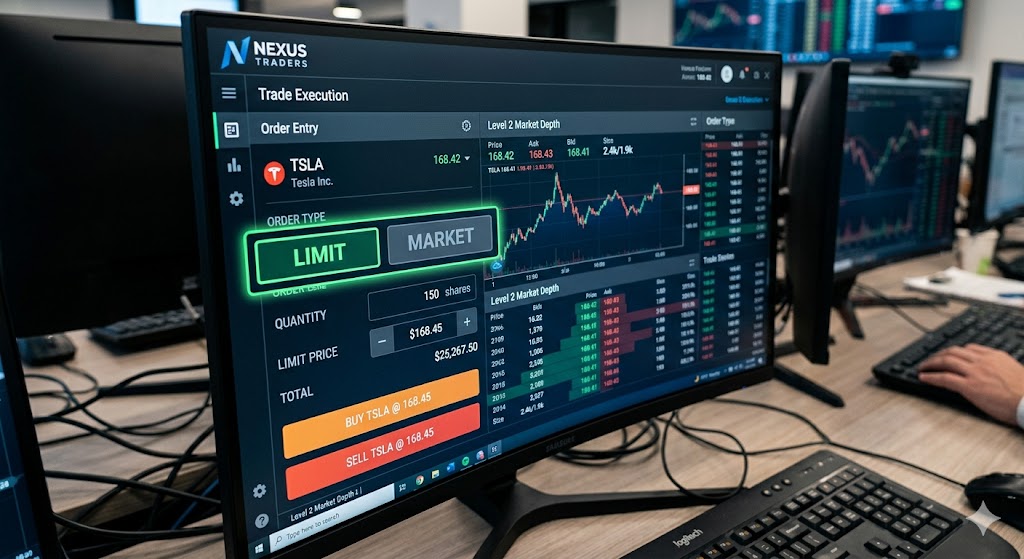
Market and limit orders are the two most commonly used tools in spot trading.
- Market orders execute instantly at the current available price
- Limit orders execute only at a price you choose
A market order prioritizes speed. A limit order prioritizes precision.
Understanding when to use each is essential for building a structured approach.
How Market Orders Work in Spot Trading
Market orders are the simplest way to enter or exit a trade.
- You select the asset and amount
- The trade executes immediately
- The final price may vary slightly due to market movement
These orders are useful when:
- You want to enter a position quickly
- The market is moving fast
- Execution matters more than exact price
However, in volatile conditions, the price you receive may differ from what you expect.
How Limit Orders Work in Spot Trading
Limit orders give you control over the price at which your trade executes.
- You set a specific buy or sell price
- The order waits until the market reaches that level
- Execution is not guaranteed
These orders are useful when:
- You want to buy at a lower price or sell higher
- You are trading within a defined range
- You prefer patience over immediate execution
Limit orders are often used to plan trades in advance.
Market vs Limit Orders Comparison
| Feature | Market Order | Limit Order |
|---|---|---|
| Execution Speed | Immediate | Conditional |
| Price Control | Low | High |
| Certainty of Execution | High | Not guaranteed |
| Slippage Risk | Higher | Lower |
| Best Use | Fast entry/exit | Planned trades |
This comparison highlights the trade-off between speed and control.
Pro Insight
Many experienced traders combine both order types. They may use limit orders to enter positions at favorable prices and market orders to exit quickly when conditions change.
Practical Spot Trading Methods Using Orders
Breakout Entry with Market Orders
When price moves strongly beyond a key level:
- Use a market order to enter quickly
- Focus on momentum rather than precision
- Accept minor price variation
This approach is common in fast-moving markets.
Buy the Dip with Limit Orders
When you expect a temporary price drop:
- Place a limit order below current price
- Wait for the market to reach your level
- Enter at a more favorable price
This method requires patience but can improve entry points.
Range Trading with Limit Orders
In a sideways market:
- Place buy limits near support
- Place sell limits near resistance
- Repeat within the range
This method relies on predictable price movement.
Quick Exit Strategy with Market Orders
When conditions change unexpectedly:
- Use a market order to exit immediately
- Avoid delays that could increase losses
Speed becomes more important than price precision.
Quick Tip
Avoid placing market orders during low liquidity periods. Prices can move quickly, leading to less favorable execution.
Managing Risk Without Leverage
Even without borrowed funds, discipline remains important.
- Set clear entry and exit points
- Avoid emotional decisions
- Use position sizing to manage exposure
- Track performance over time
Combining structured orders with risk management creates a more stable approach.
Real-world Scenario
A trader sees an asset trading at $100 within a steady range.
- They place a limit buy order at $95
- The price dips and the order fills
- Later, they place a limit sell at $105
The trade completes without constant monitoring.
In another case, a sudden news event causes a sharp drop:
- The trader uses a market order to exit immediately
This combination of order types helps adapt to different conditions.
Common Mistakes to Avoid
- Using market orders in highly volatile conditions without awareness
- Setting unrealistic limit prices that never execute
- Ignoring fees from frequent trading
- Failing to plan exits in advance
- Overcomplicating simple strategies
Clarity and consistency often outperform complexity.
Frequently Asked Questions
Should beginners use market or limit orders
Many beginners start with market orders for simplicity, then learn limit orders for better price control.
Can a limit order fail to execute
Yes, if the market never reaches your specified price, the order remains unfilled.
Are market orders risky
They can be in volatile markets due to price slippage, but they ensure execution.
Do I need both order types
Using both provides flexibility and allows you to adapt to different market conditions.
Is spot trading profitable without leverage
It can be, depending on strategy, discipline, and market understanding.
Conclusion
Spot trading using market and limit orders offers a balanced approach between speed and control. By understanding how each order type works and applying them strategically, you can improve trade execution and reduce unnecessary risks.
A simple, well-structured method often proves more effective than overly complex strategies—especially when trading without leverage.
Trusted U.S. Resources
https://www.investor.gov
https://www.sec.gov
https://www.cftc.gov
https://www.finra.org
This article is for general informational purposes only and does not provide legal, financial, medical, or professional advice. Policies, rates, and regulations may change over time.