

 wewe
wewe 
Private key security is one of the most critical aspects of managing cryptocurrency. Your private key is what gives you access to your digital assets—if someone else gains access to it, they can control your funds.
Unlike traditional banking, there is no central authority to recover lost or stolen keys. That makes proper security practices essential.
What Is a Private Key in Crypto

A private key is a cryptographic code that allows you to access and manage your cryptocurrency.
It is used to:
- Sign transactions
- Prove ownership of funds
- Authorize transfers
Anyone with access to your private key can move your assets, which is why it must remain confidential at all times.
Why Private Key Security Matters
Private keys are the foundation of crypto ownership.
If your key is:
- Stolen → funds can be transferred without permission
- Lost → access to your assets may be permanently gone
- Exposed → security is compromised immediately
There is typically no way to reverse transactions or recover funds once they are gone.
Common Storage Methods Compared
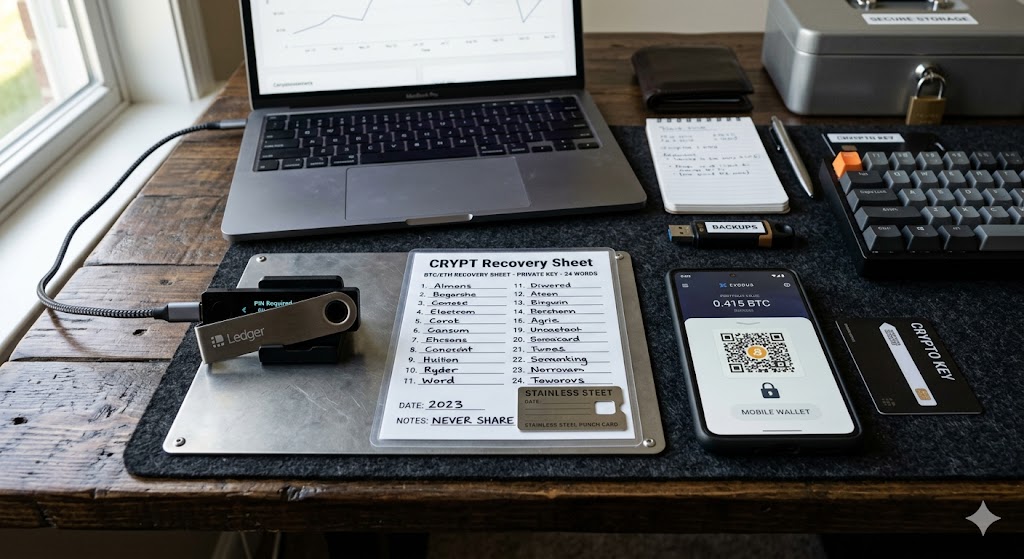
| Storage Method | Security Level | Convenience |
|---|---|---|
| Hardware wallet | Very high | Moderate |
| Paper backup | High | Low |
| Mobile wallet | Medium | High |
| Exchange wallet | Lower | Very high |
Cold storage options generally provide stronger protection than online methods.
Pro Insight
The biggest risk is not always hacking—it’s human error. Misplacing a recovery phrase or storing it insecurely is one of the most common causes of lost crypto assets.
Best Practices for Private Key Security
Strong habits can significantly reduce risk.
Keep keys offline
Use hardware wallets or secure physical storage.
Never share your private key
No legitimate service will ask for it.
Use secure backups
Store recovery phrases in multiple safe locations.
Enable additional security layers
Use PINs or passphrases where available.
Verify websites and apps
Avoid phishing attacks and fake platforms.
Consistency in these practices is key.
Quick Tip
Write your recovery phrase on paper and store it in a secure place. Avoid saving it digitally, where it may be exposed to malware.
Real-World Micro Scenario
A crypto user stores their private key in a note on their phone. After downloading a malicious app, their device is compromised, and their funds are transferred out.
Another user keeps their keys on a hardware wallet with an offline backup. Even if their computer is compromised, their assets remain secure.
The difference lies in how the keys are stored.
Common Mistakes to Avoid
Even experienced users can make critical errors.
Storing keys online
Cloud storage or email can be vulnerable.
Taking screenshots of recovery phrases
Images can be accessed or leaked.
Using untrusted devices
Public or shared devices increase risk.
Ignoring backups
Without backups, loss can be permanent.
Frequently Asked Questions
What is a private key in simple terms?
It’s a secret code that gives you access to your cryptocurrency.
Can someone steal my crypto with my private key?
Yes, anyone with your private key can control and transfer your funds.
Is it safe to store private keys digitally?
It’s generally safer to store them offline to reduce exposure to hacking.
What happens if I lose my private key?
You may permanently lose access to your cryptocurrency.
Are hardware wallets the safest option?
They are considered one of the most secure methods for storing private keys.
Conclusion
Private key security is the foundation of safe cryptocurrency ownership. Without proper protection, digital assets can be lost or stolen with little chance of recovery.
By using secure storage methods and following consistent safety practices, you can significantly reduce risk and maintain full control over your crypto holdings.
Trusted U.S. Resources
https://www.sec.gov
https://www.investor.gov
https://www.cftc.gov
https://www.usa.gov
This article is for general informational purposes only and does not provide legal, financial, medical, or professional advice. Policies, rates, and regulations may change over time.