

 wewe
wewe 
In trading and investing, one mistake can erase months of gains. That’s why position sizing is one of the most critical — and most overlooked — elements of risk management.
In 2026’s fast-moving markets, from equities to crypto, traders focus heavily on entry signals. However, professionals know that how much you risk per trade often matters more than when you enter.
Position sizing isn’t about predicting markets perfectly. It’s about surviving long enough to benefit from them.
This article is for general informational purposes only and does not provide legal, financial, medical, or professional advice. Policies, rates, and regulations may change over time.
What Is Position Sizing?
Position sizing determines how much capital you allocate to a single trade or investment.
Instead of investing a random amount, disciplined traders calculate position size based on:
- Total portfolio value
- Maximum risk tolerance
- Stop-loss level
- Volatility
For example, if a trader has a $50,000 account and decides to risk only 1% per trade, the maximum acceptable loss per trade would be $500.
Why Position Sizing Matters
Even strong strategies experience losing trades.
Without structured sizing:
- One oversized position can cause severe drawdowns
- Emotional trading increases after losses
- Recovery becomes harder
Consider two traders with identical strategies:
- Trader A risks 1% per trade
- Trader B risks 10% per trade
After three consecutive losses, Trader A remains stable. Trader B may face substantial capital erosion.
Survival enables long-term growth.
Common Position Sizing Methods
| Method | How It Works | Best For |
|---|---|---|
| Fixed Percentage | Risk a set % of account per trade | Most traders |
| Fixed Dollar | Risk same dollar amount each trade | Smaller accounts |
| Volatility-Based | Adjust size based on asset volatility | Active traders |
| Kelly Criterion | Formula-based optimization | Advanced traders |
Each method balances risk and growth differently.

The 1–2% Rule
Many experienced traders follow a simple rule: risk no more than 1–2% of total capital per trade.
Why?
Because drawdowns compound quickly.
If you lose 50% of your account, you must gain 100% to recover. Smaller risk per trade reduces the probability of catastrophic loss.
For instance, risking 1% across 10 consecutive losing trades results in roughly a 10% drawdown — manageable compared to risking 10% per trade.
Pro Insight
Position sizing works best when combined with predefined stop-loss levels. Without a clear exit point, calculated risk loses meaning.
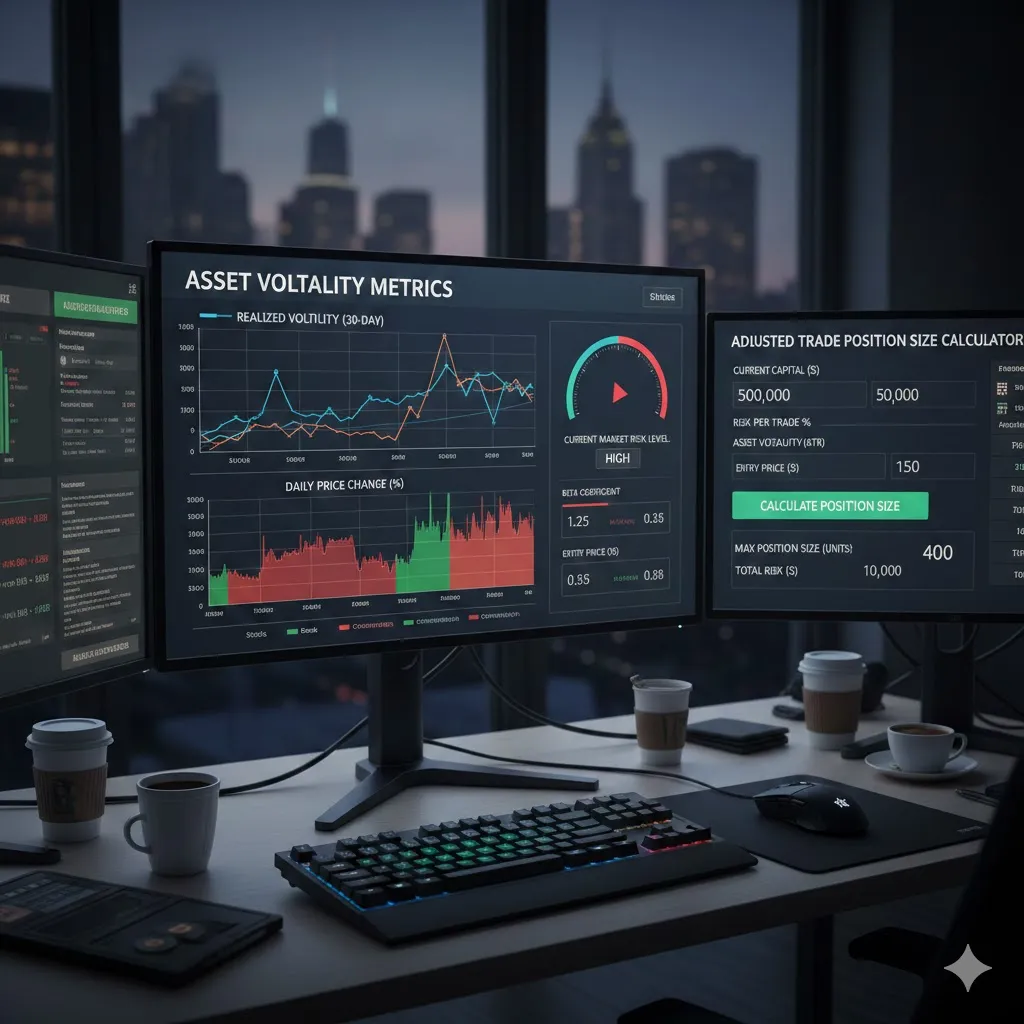
Volatility-Based Position Sizing
Assets with higher volatility require smaller position sizes.
For example:
- A stable large-cap stock may allow a larger position
- A highly volatile crypto asset may require smaller exposure
Adjusting for volatility protects capital during unpredictable swings.
Psychological Benefits
Position sizing also stabilizes emotions.
When risk is predefined:
- Fear decreases
- Impulse decisions decline
- Discipline improves
Traders often make poor decisions after large losses. Smaller, controlled losses protect mental clarity.
Quick Tip
Before entering any trade, calculate three numbers: entry price, stop-loss level, and maximum dollar risk. Only then determine your position size.
Frequently Asked Questions
Is position sizing more important than entry timing?
Many professionals believe risk control outweighs precise timing.
Does position sizing guarantee profits?
No. It manages downside risk but cannot eliminate market uncertainty.
Should beginners use the Kelly Criterion?
Most beginners benefit from simple fixed-percentage methods before using advanced formulas.
Does position sizing apply to long-term investors?
Yes. Asset allocation and portfolio weighting are forms of position sizing.
Can I increase position size after wins?
Gradually adjusting size based on portfolio growth is common, but avoid overexposure.
Conclusion
Position sizing is the foundation of sustainable trading and investing in 2026. By controlling how much capital you risk per trade, adjusting for volatility, and combining sizing with disciplined stop-loss strategies, you improve resilience and longevity in the markets.
Profits attract attention. Risk control builds wealth.
Trusted U.S. Resources
U.S. Securities and Exchange Commission (SEC) – Investor Education
https://www.sec.gov/
Financial Industry Regulatory Authority (FINRA) – Investor Tools
https://www.finra.org/
Commodity Futures Trading Commission (CFTC) – Risk Disclosure
https://www.cftc.gov/
National Institute of Standards and Technology (NIST) – Risk Management Framework
https://www.nist.gov/