
 wewe
wewe 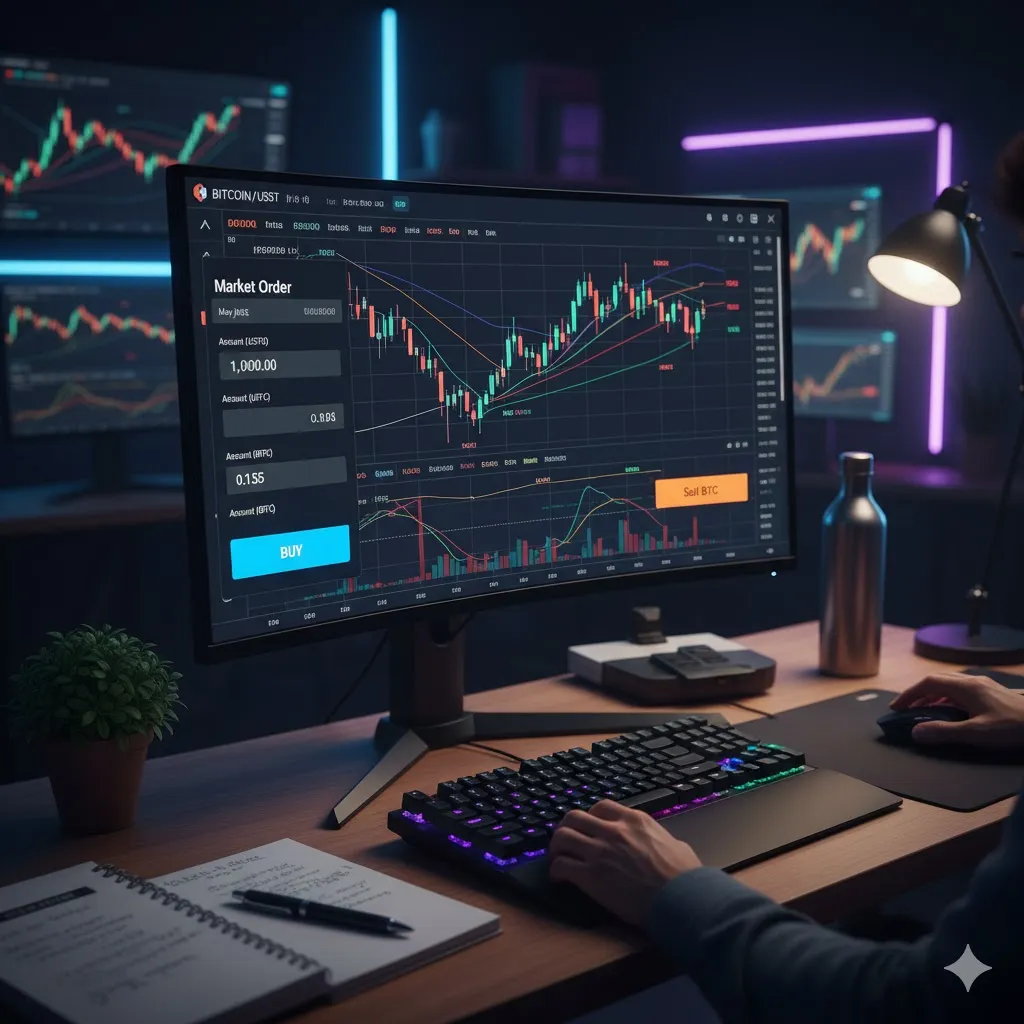
A market order is the simplest and fastest way to buy or sell an asset. Instead of choosing a specific price, you tell the market you want the trade executed immediately at the best available price. This makes market orders popular in fast-moving markets where speed matters more than precision.
In 2025, market orders are widely used across stocks, crypto, and other liquid assets—especially by traders who prioritize execution certainty over price control.
🔒 Disclaimer: This article is for educational purposes only and does not provide financial, legal, or investment advice. Trading involves risk, and execution prices can vary based on market conditions.
What a market order really means
A market order is an instruction to buy or sell an asset right now at the current market price. The trade executes instantly by matching your order with the best available opposite order in the order book.
You don’t control the exact price—you accept whatever price the market offers at that moment.
For example, if a crypto asset is rapidly rising and you want in immediately, a market order ensures execution without waiting for a specific price level.
How market orders work behind the scenes
When you place a market order, the exchange fills it using existing orders in the order book. If liquidity is high, execution is usually very close to the displayed price. If liquidity is low, the order may fill across multiple price levels.
A realistic scenario: during a sudden price spike, a large market order may execute at slightly worse prices than expected due to limited sell orders at the top level.
This price difference is known as slippage.
Market order vs limit order
Understanding this distinction is essential for smart trading.
| Order Type | Price Control | Execution Speed | Typical Use |
|---|---|---|---|
| Market order | None | Immediate | Urgent entries or exits |
| Limit order | Full control | Not guaranteed | Strategic price targeting |
Market orders guarantee execution but not price. Limit orders guarantee price but not execution.
Pro Insight: Experienced traders often use market orders to exit risk quickly and limit orders to enter positions with precision.
When using a market order makes sense
Market orders are commonly used when:
- Speed is more important than price
- Markets are highly liquid
- You need to exit a position immediately
- Small price differences are acceptable
For example, a trader may use a market order to exit during a sudden news event rather than risk waiting for a limit order to fill.
Quick Tip: Market orders work best in assets with high trading volume to reduce slippage.
Risks and downsides to consider
The biggest risk of a market order is unexpected execution price. In volatile or illiquid markets, the final price may differ noticeably from what you see on screen.
Other limitations include:
- Slippage during fast moves
- Less control during low liquidity
- Potentially higher fees on some platforms
Being aware of market conditions helps decide when market orders are appropriate.
Market orders in crypto vs stock markets
Market orders behave similarly across markets, but conditions differ:
- Stocks: Limited to trading hours, generally deep liquidity
- Crypto: 24/7 trading, higher volatility, liquidity varies by asset
In crypto markets, market orders are especially useful during overnight moves when monitoring prices constantly isn’t practical.
Frequently asked questions about market orders
Does a market order guarantee execution?
Yes. It executes immediately at the best available price.
Do market orders guarantee price?
No. The final price depends on available liquidity.
Are market orders good for beginners?
Yes, but beginners should understand slippage and volatility first.
Can market orders cause losses?
They can if executed during volatile or low-liquidity conditions.
Are fees higher for market orders?
Some exchanges charge higher taker fees for market orders.
Trusted U.S. sources for further reading
- U.S. Securities and Exchange Commission (SEC) – https://www.sec.gov
- FINRA Investor Education Foundation – https://www.finra.org
- Commodity Futures Trading Commission (CFTC) – https://www.cftc.gov
- Consumer Financial Protection Bureau (CFPB) – https://www.consumerfinance.gov