

 wewe
wewe 
Understand crypto on-chain data in 2026 with practical examples, key metrics, and simple ways traders use blockchain data to read real market behavior.
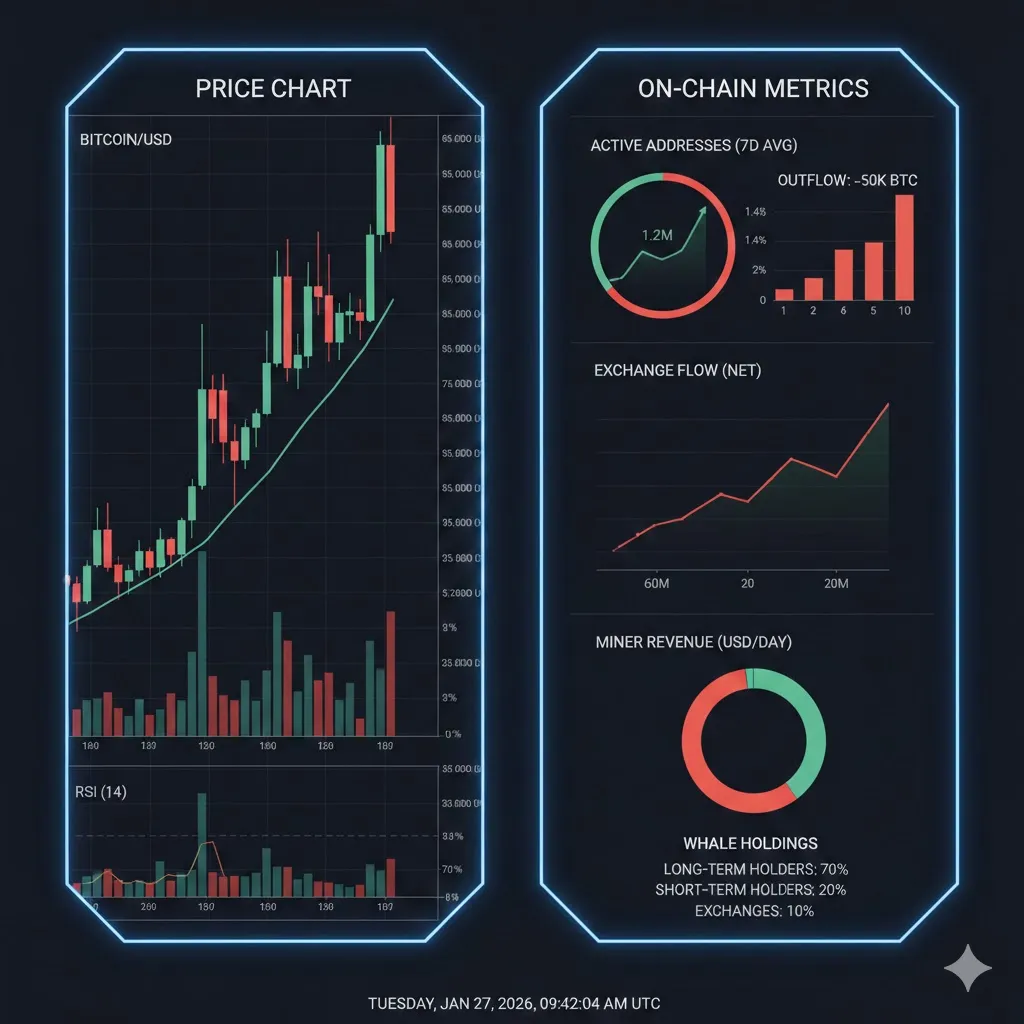
Price charts show movement. News shows narratives. Crypto on-chain data shows what people are actually doing on the blockchain. That’s why many traders and long-term investors rely on on-chain signals to understand demand, fear, and hidden risk before big moves happen.
Still, on-chain data isn’t about predicting exact prices. It’s about context. When used correctly, it helps you avoid emotional trades and spot conditions that charts alone often miss.
For example, if prices rise while coins quietly move onto exchanges, that tension matters. It doesn’t guarantee a drop, but it changes how you manage risk.
What Crypto On-Chain Data Really Means
Crypto on-chain data comes directly from blockchain activity. Every transaction, wallet movement, and transfer is recorded publicly.
Common on-chain data includes:
- wallet balances
- exchange inflows and outflows
- transaction volume
- active addresses
- long-term vs short-term holder behavior
Because blockchains are transparent, this data reflects real behavior, not opinions.
If you trade derivatives, pairing on-chain signals with a futures trading strategy helps you avoid crowded trades driven purely by leverage.
Why Traders Use On-Chain Data
On-chain data helps answer questions price charts cannot.
Traders often use it to understand:
- whether holders are accumulating or selling
- if exchanges are receiving coins (potential sell pressure)
- if network activity is growing or fading
- whether rallies are supported by real demand
Real-life micro-scenario:
Bitcoin price moves sideways, but exchange outflows increase steadily. Some traders interpret this as accumulation and reduce short exposure. Days later, price breaks upward. The data didn’t predict the move — it helped manage positioning.
That’s the real value of on-chain data: awareness.
The Most Important Crypto On-Chain Metrics
Exchange inflows and outflows
This is one of the most watched metrics.
- Rising inflows may signal potential selling
- Rising outflows may signal accumulation
Context matters. Not all inflows lead to selling, but sharp spikes deserve attention.
Active addresses
This measures how many unique addresses interact with the network. Growth can suggest increasing interest, but spikes can also come from bots or temporary hype.
Transaction volume
High volume can reflect real usage or internal movements. Comparing it with price helps separate noise from demand.
Holder behavior
Many tools separate wallets into short-term and long-term holders. This helps identify distribution versus accumulation phases.
Understanding these basics helps you avoid overreacting to a single data point.
On-Chain Data vs Technical Analysis
| Feature | On-Chain Data | Technical Analysis |
|---|---|---|
| Data source | Blockchain activity | Price & volume |
| Best use | Market behavior | Entry & exit timing |
| Strength | Shows real transfers | Clear structure |
| Weakness | Can be slow or noisy | Misses hidden flows |
| Ideal approach | Confirmation | Execution |
This is why many experienced traders combine both instead of choosing one.
How On-Chain Data Helps Manage Risk
On-chain data is especially useful for risk control, not just trade ideas.
It can help you:
- avoid buying into overheated rallies
- reduce leverage during heavy exchange inflows
- spot early signs of distribution
- confirm whether a breakout has real support
For leveraged traders, combining this with funding rates and liquidation data gives even better context.
Pro Insight
On-chain data works best when it confirms what price is already hinting at. When both disagree strongly, caution usually wins.
Common Mistakes When Using On-Chain Data
Treating it as a crystal ball
On-chain data shows behavior, not certainty.
Ignoring timeframes
Some metrics work over weeks, not hours. Using them for short-term trades can cause confusion.
Focusing on one metric only
One data point without context can be misleading.
Forgetting market structure
On-chain data can look bullish while price structure breaks down. Confirmation matters.
A risk management checklist mindset helps keep on-chain insights grounded.

Quick Tip
Always check exchange inflows before entering a large position. Sudden spikes often signal increased volatility ahead.
FAQs About Crypto On-Chain Data
Is crypto on-chain data free to access?
Some basic data is free, while advanced analytics tools often require paid plans.
Does on-chain data work for all cryptocurrencies?
It works best for transparent blockchains like Bitcoin and Ethereum. Smaller chains may have limited data quality.
Can on-chain data predict price direction?
No. It provides context and risk signals, not guaranteed predictions.
Is on-chain data useful for day trading?
Sometimes, but it’s more reliable for short- to mid-term context rather than minute-by-minute decisions.
Should beginners use on-chain data?
Yes, if they start with simple metrics like exchange flows and avoid overcomplicating analysis.
Disclaimer
This article is for general informational purposes only and does not provide financial or investment advice. Crypto markets are volatile, and on-chain data does not guarantee outcomes.