

 wewe
wewe 
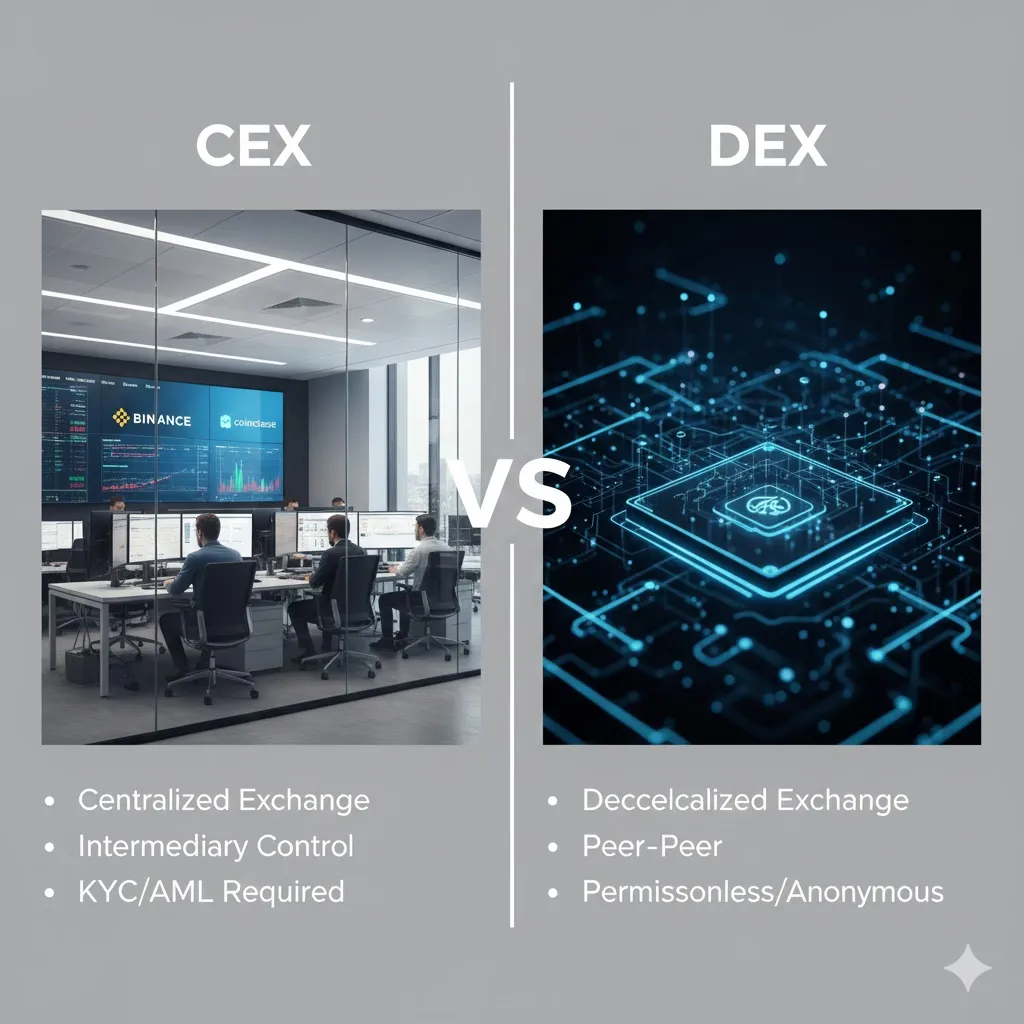
Choosing between a centralized exchange (CEX) and a decentralized exchange (DEX) is one of the first real decisions crypto users face. While both allow you to buy, sell, and trade digital assets, they operate on very different principles.
In 2025, as crypto adoption matures and regulations evolve, the CEX vs DEX debate is no longer about which is “better,” but which is more appropriate for specific goals, experience levels, and risk tolerance.
Disclaimer: This article is for educational purposes only and does not provide financial, legal, or investment advice. Cryptocurrency markets involve risk, and individual circumstances vary.
What a CEX really is
A centralized exchange (CEX) is a crypto trading platform operated by a company that acts as an intermediary between buyers and sellers. These platforms manage order books, custody of funds, and often user verification.
Popular examples include large global platforms where users create accounts, deposit funds, and trade through a familiar interface. For many beginners, a CEX feels similar to online banking or stock trading.
A common real-life scenario looks like this: someone new to crypto wants to buy Bitcoin using a debit card. They sign up on a centralized exchange, verify their identity, and complete the purchase within minutes.
How a DEX works differently
A decentralized exchange (DEX) removes the middleman. Instead of a company controlling the platform, trades happen directly between users through smart contracts on a blockchain.
DEXs connect to crypto wallets rather than accounts, and users retain full control over their funds at all times. There’s no central authority holding assets or approving transactions.
For example, an experienced user with a self-custody wallet might swap tokens directly on a DEX without ever sharing personal information or depositing funds into a platform-controlled wallet.
CEX vs DEX: a side-by-side comparison
The differences between CEXs and DEXs become clearer when viewed together.
| Feature | Centralized Exchange (CEX) | Decentralized Exchange (DEX) |
|---|---|---|
| Asset custody | Platform holds funds | User controls funds |
| Account setup | Registration often required | Wallet connection only |
| Ease of use | Beginner-friendly | Steeper learning curve |
| Privacy | Limited | Higher |
| Regulatory oversight | More structured | Minimal or evolving |
Each model reflects a different philosophy: convenience versus autonomy.
Pro Insight: As regulations tighten globally, many traders now use both—CEXs for fiat access and DEXs for on-chain flexibility.
Security and risk considerations
Security is often central to the CEX vs DEX discussion. Centralized exchanges invest heavily in security infrastructure, but they also present a single point of failure. History has shown that large platforms can be targeted by hackers or affected by operational issues.
DEXs reduce custodial risk because users hold their own keys. However, smart contract vulnerabilities, phishing scams, and user error can still lead to losses.
A realistic scenario: a user accidentally approves a malicious smart contract on a DEX and loses funds. In this case, there’s usually no customer support to reverse the transaction.
Quick Tip: If you’re using a DEX, always verify token contracts and transaction permissions before approving a trade.
Fees, liquidity, and trading experience
CEXs typically offer deeper liquidity and faster execution for high-volume trades. Fees are often predictable, though they may include withdrawal costs.
DEX fees depend on network congestion and gas prices, which can fluctuate. Liquidity varies by blockchain and trading pair, though it has improved significantly by 2025.
For active traders, execution speed and slippage may influence platform choice more than ideology.
Choosing between CEX and DEX in 2025
The right choice depends on your goals. Beginners often prefer CEXs for simplicity, customer support, and fiat onramps. Advanced users may lean toward DEXs for privacy, self-custody, and access to newer tokens.
Many long-term crypto users blend both approaches, using each where it makes the most sense rather than committing to one exclusively.
Frequently asked questions about CEX vs DEX
Is a CEX safer than a DEX?
Both have risks. CEXs face custodial and regulatory risks, while DEXs rely on smart contract security and user responsibility.
Do DEXs require identity verification?
Most DEXs do not require personal identification, as they connect directly to wallets.
Can beginners use a DEX?
Yes, but beginners should proceed carefully and learn wallet security basics first.
Why do CEXs freeze accounts sometimes?
Account freezes can occur due to compliance requirements, security reviews, or regulatory obligations.
Will DEXs replace CEXs?
In 2025, they serve different purposes and are more likely to coexist than replace each other.
Trusted U.S. sources for further reading
- U.S. Securities and Exchange Commission (SEC) – https://www.sec.gov
- Commodity Futures Trading Commission (CFTC) – https://www.cftc.gov
- Consumer Financial Protection Bureau (CFPB) – https://www.consumerfinance.gov
- National Institute of Standards and Technology (NIST) – https://www.nist.gov