
 wewe
wewe 
In today’s data-driven markets, backtesting models has become a core discipline for traders, quants, and financial analysts. Before risking real capital, professionals test strategies against historical data to evaluate performance under past market conditions.
However, backtesting is not about proving you’re right. It’s about exposing weaknesses before real money is involved. In 2026, with AI-powered trading systems and algorithmic platforms more accessible than ever, rigorous backtesting separates serious strategy builders from overconfident guessers.
This article is for general informational purposes only and does not provide legal, financial, medical, or professional advice. Policies, rates, and regulations may change over time.
What Backtesting Models Actually Means
Backtesting models involves applying a trading or investment strategy to historical market data to see how it would have performed.
For example, imagine developing a simple rule:
- Buy when a stock’s 50-day moving average crosses above its 200-day moving average
- Sell when it crosses below
By applying this rule to 10 years of historical data, you can measure:
- Total return
- Maximum drawdown
- Win/loss ratio
- Volatility
Why Backtesting Is Critical in 2026
Markets evolve rapidly. Algorithmic trading, AI-driven signals, and high-frequency systems influence price behavior. A strategy that worked in 2015 may fail under 2026 liquidity conditions.
Backtesting helps you:
Evaluate Risk Before Capital Deployment
Instead of guessing how a model behaves in downturns, you can analyze how it performed during historical stress periods like inflation spikes or rate hikes.
Compare Competing Strategies
If two models generate similar returns, backtesting highlights which one carries lower volatility or smaller drawdowns.
Identify Hidden Flaws
For instance, a strategy might show strong annual returns but collapse during sharp corrections.
Core Components of Reliable Backtesting
| Component | Why It Matters | Risk If Ignored |
|---|---|---|
| Clean Historical Data | Prevents false signals | Biased results |
| Transaction Costs | Reflects real trading friction | Inflated profits |
| Slippage Modeling | Accounts for execution delays | Unrealistic performance |
| Out-of-Sample Testing | Validates robustness | Overfitting |
| Risk Metrics | Measures downside exposure | Hidden volatility |
Without these components, backtesting becomes misleading rather than informative.
Common Mistakes in Backtesting Models
Overfitting
This happens when a model is too perfectly tuned to past data. It looks brilliant historically but fails in live trading.
For example, adjusting parameters dozens of times until historical performance looks ideal often creates a fragile model.
Ignoring Transaction Costs
Brokerage fees, bid-ask spreads, and slippage can significantly reduce real-world returns.
Look-Ahead Bias
Using information that wasn’t available at the time of trade execution leads to unrealistic results.
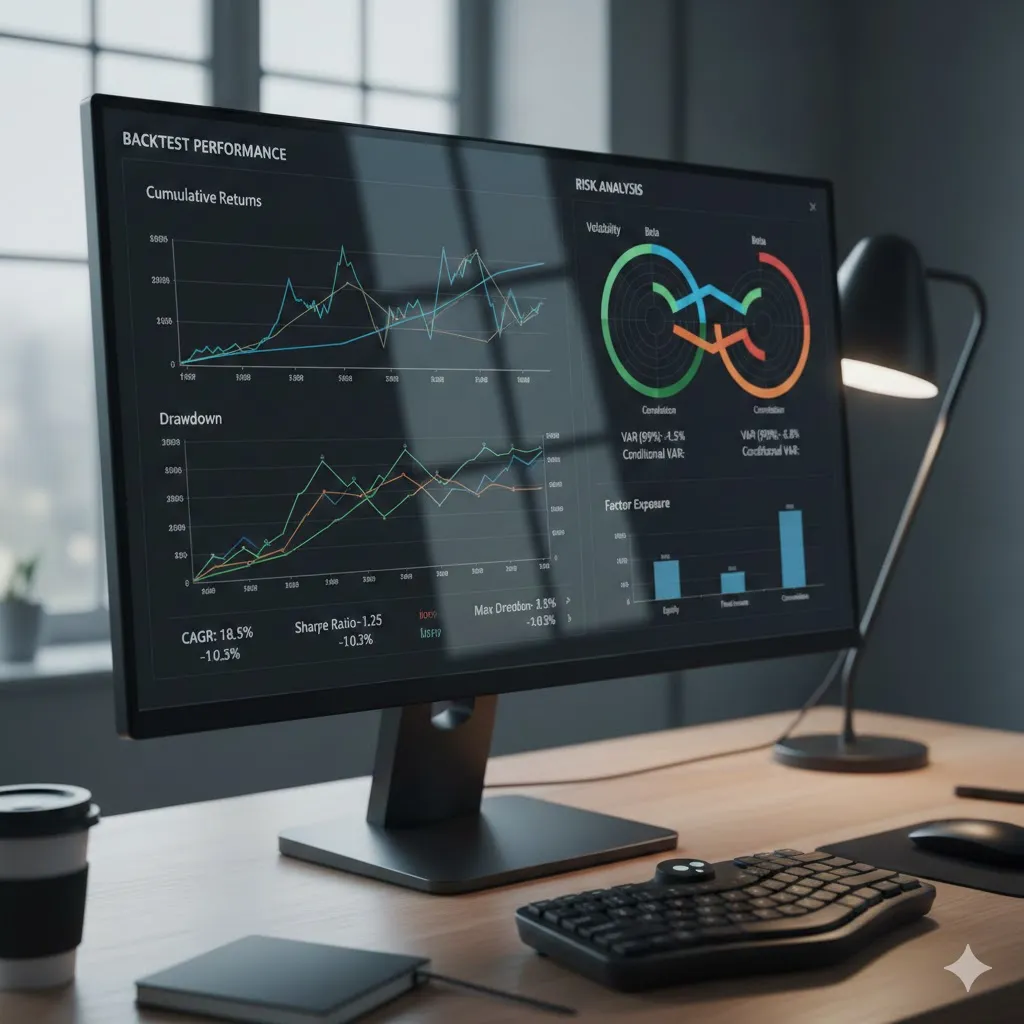
Pro Insight
Robust backtesting separates data into training, validation, and out-of-sample testing periods. If performance remains consistent across all three, the strategy is more likely to survive live conditions.
Tools Used for Backtesting in 2026
Today’s investors have access to sophisticated platforms:
- Python libraries like Backtrader and Zipline
- Quantitative platforms with API integration
- Brokerage-provided strategy simulators
- AI-enhanced modeling environments
Meanwhile, cloud computing allows traders to test years of high-frequency data within minutes.
However, tools don’t replace discipline. Model logic and risk management matter more than software sophistication.
Quick Tip
Always test your model on data it has never “seen” before. Out-of-sample performance is one of the strongest indicators of real-world viability.
Frequently Asked Questions
What is the main purpose of backtesting models?
To evaluate how a trading or investment strategy would have performed using historical data before applying it in live markets.
Can backtesting guarantee future profits?
No. Past performance does not guarantee future results, but it helps assess risk and structural reliability.
How much historical data should I use?
It depends on strategy type, but testing across multiple market cycles improves robustness.
Is backtesting only for algorithmic traders?
No. Even discretionary investors can backtest rule-based strategies.
What is walk-forward analysis?
A method that repeatedly re-optimizes and tests a strategy across rolling time periods to simulate real-world adaptation.
Conclusion
Backtesting models is not about building the perfect historical equity curve. It’s about stress-testing ideas, uncovering hidden weaknesses, and improving decision-making before capital is at risk.
In 2026’s fast-moving markets, disciplined backtesting — combined with realistic assumptions and risk controls — remains one of the most valuable tools for traders and quantitative investors alike.
Trusted U.S. Resources
U.S. Securities and Exchange Commission (SEC) – Investor Information
https://www.sec.gov/
Financial Industry Regulatory Authority (FINRA) – Investor Resources
https://www.finra.org/
Commodity Futures Trading Commission (CFTC) – Market Education
https://www.cftc.gov/
National Institute of Standards and Technology (NIST) – Risk Management Framework
https://www.nist.gov/