

 wewe
wewe 
Learn API trading in crypto, key risks, security best practices, and how to automate safely without losing control of your account.
If you’re exploring API trading crypto, you’re probably chasing one thing: consistent execution. APIs can automate orders, manage risk rules, and run 24/7—without emotional clicks. However, the same speed that helps you can also magnify mistakes fast, especially when security or permissions are sloppy.
This guide breaks down how API trading works, what actually matters in 2026, and how to keep your setup safer and more reliable.
What API Trading in Crypto Actually Means
API trading is when you connect software (a bot, trading terminal, or custom script) to a crypto exchange via an API key so it can place and manage trades on your behalf. Instead of logging in and clicking “Buy,” your system sends authenticated requests that can create orders, cancel orders, read balances, and track fills.
A micro-scenario: you set a rule to reduce exposure if volatility spikes. While you’re in a meeting, your system detects the condition, cancels open orders, tightens risk, and exits a position—without you touching the keyboard. That’s the real advantage: structured execution, not prediction.
The API Features That Matter Most
Not all API setups are equal. What you enable determines how much damage is possible when something goes wrong.
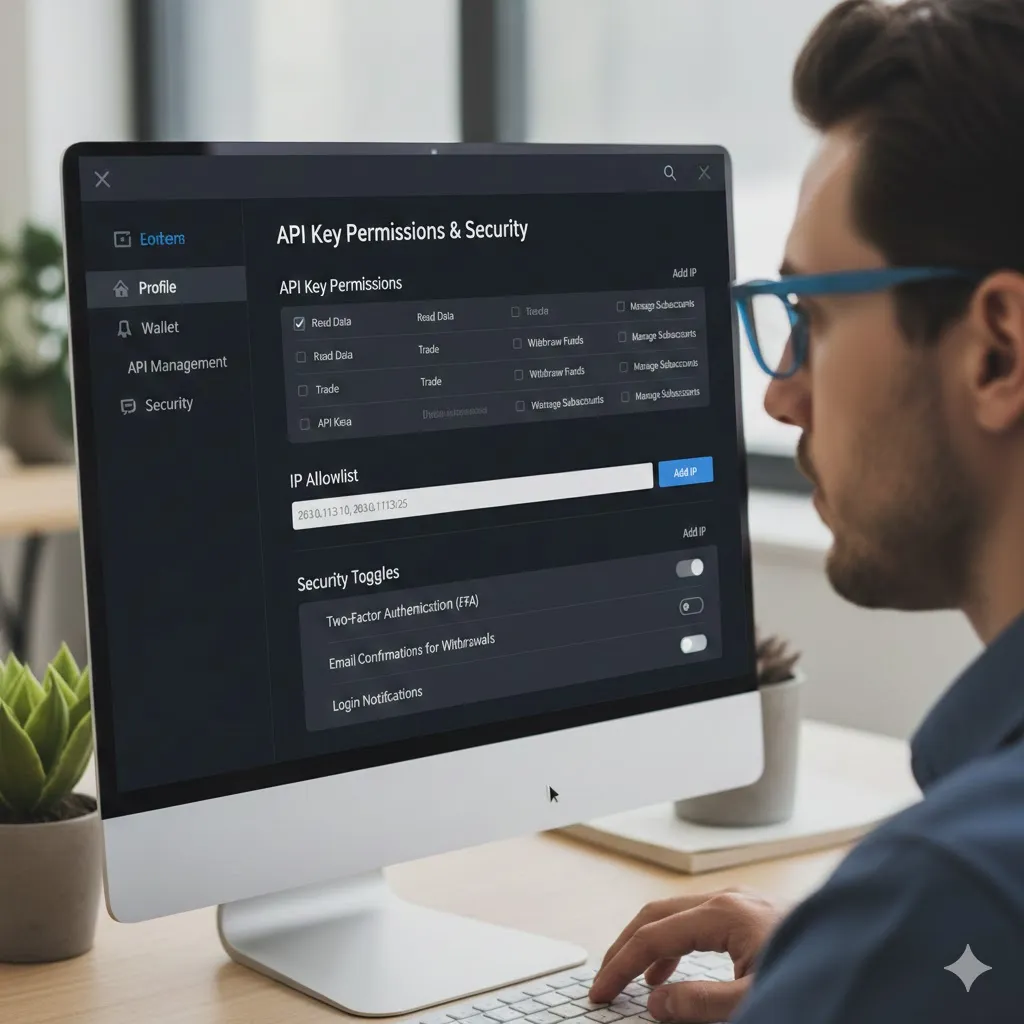
Read vs trade permissions
The safest starting point is “read-only” access so you can monitor balances and markets without placing orders. Trading permissions should be added only when you’ve tested your logic and controls.
Order types and rate limits
Some strategies depend on specific order types (limit, market, stop). Exchanges also enforce rate limits; if your system spams requests, you may get throttled at the worst time.
Webhooks and callbacks
Reliable fills tracking matters more than fancy signals. If your system can’t confirm what executed, it can double-enter or fail to exit.
Exchange-specific behavior
Even when two exchanges offer “the same” endpoints, the fine print differs—minimum order sizes, tick sizes, margin rules, and how stop orders trigger.
Security Rules That Keep Your Account Safe
If you remember only one thing, make it this: API trading is a security problem first, and a trading problem second.
- Never enable withdrawals on trading keys unless you have a very specific, audited reason.
- Use IP allowlisting if your exchange supports it, so the key only works from your server/device.
- Store keys securely (a password manager or secrets vault), not in plain text notes or screenshots.
- Rotate keys periodically, especially after device changes or team turnover.
- Treat “copy trading” and unknown bot services carefully—your API key is effectively the steering wheel.
Compare Popular API Trading Approaches
| Approach | Best For | Main Benefit | Biggest Risk |
|---|---|---|---|
| Exchange-built bots | Beginners | Quick setup | Limited controls and transparency |
| Third-party bot platform | Convenience | Templates and UI tools | Trust, key handling, outages |
| Custom script | Advanced users | Full control | Bugs, maintenance burden |
| Trading terminal with API | Active traders | Faster execution | Misconfigured hotkeys/rules |
| Paper trading via API | Testing | Safe validation | False confidence vs live slippage |
Risk Controls That Separate “Automation” From “Accidents”
The most reliable API traders build systems that can refuse to trade when conditions are unsafe.
Position sizing that never escalates silently
Hard caps on position size protect you from loops, retries, and duplicate fills.
Kill switch and circuit breakers
If daily loss exceeds a threshold, stop trading automatically. The goal is to prevent one bad day from becoming a month-long setback.
Slippage awareness
In fast markets, your “expected fill” can be fantasy. If your logic assumes perfect execution, it will break when volatility hits.
Logging you can actually read
When something goes wrong, you should be able to answer: what was the signal, what orders were sent, what filled, and what the system believed at the time.
This article is for general informational purposes only and does not constitute financial, legal, or investment advice. Crypto trading involves risk, and outcomes depend on market conditions and individual circumstances.
Pro Insight
The best API trading setups are boring: limited permissions, strict caps, and a system that pauses more often than it trades when conditions look abnormal.
Quick Tip
Start with a read-only API key for a week of monitoring and logging before you ever allow trading permissions—most “bot disasters” begin with skipping this step.

Frequently Asked Questions
Is API trading allowed on most crypto exchanges?
Many exchanges allow it, but rules and limits vary by platform. Always follow the exchange’s API terms and restrictions.
Will API trading automatically make me profitable?
No. APIs improve execution and consistency, but they don’t create an edge by themselves.
What’s the safest way to start API trading?
Begin with read-only access, then paper testing, then small-size live testing with strict caps and a kill switch.
Can API trading increase losses?
Yes. Automation can repeat mistakes quickly if risk limits, permissions, or logic are flawed.
Do I need coding to use API trading?
Not always. Some platforms provide no-code tools, but you still need to understand permissions, limits, and risk controls.
Conclusion
API trading crypto can be a powerful upgrade when it’s built around safety: minimal permissions, realistic execution assumptions, and hard limits that prevent runaway behavior. If you treat automation as disciplined infrastructure—not a shortcut—you’ll protect your account and make better decisions over time.
Trusted U.S. Resources
U.S. Securities and Exchange Commission (SEC) — Investor Alerts & Bulletins
https://www.investor.gov
Commodity Futures Trading Commission (CFTC) — Customer Advisories
https://www.cftc.gov/LearnAndProtect/AdvisoriesAndArticles
FINRA — Investor Insights & Alerts
https://www.finra.org/investors/insights
NIST — Cybersecurity Guidance (Key Management & Access Control)
https://www.nist.gov/cybersecurity